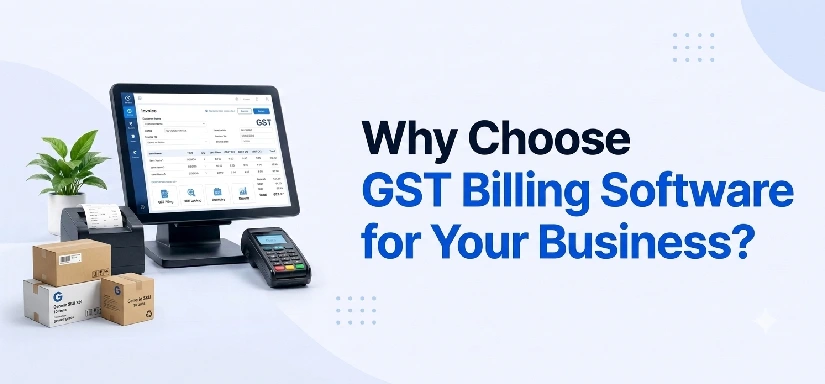
Why Choose GST Billing Software for Your Business?

Samaun Kabir
Editor
Skip this blog if you want to fall behind on taxes in 2026 and end up in unnecessary legal hassle!
For startups, retailers, distributors, and growing businesses, managing GST billing manually can become increasingly difficult. Having worked with different service domains for the past decade, I must say that if you aim for unparalleled growth in your business, especially those of you who are now startup founders or run a retail mart, prioritizing GST calculations is a MUST.
You already know what GST is, right?
Since 2017…(okay, fine, won’t repeat). If not, then read this first: What Is GST Billing Software? A Complete Guide for Indian Businesses
But managing the everyday taxation on your products (or services) manually while living in a modern era? Honestly, for how long will you continue to rack your brain like this?
That’s definitely not cool.
Let me share a very practical example.
Imagine you are a beverage distributor supplying customers in several states. One customer requires regular interstate deliveries, while another purchases weekly within the supplier's state. As sales increase, manually calculating taxes, preparing invoices, tracking inventory, and monitoring payments becomes increasingly difficult.
Both are promising.
Now that you are new to the business or have just suddenly started to gain momentum, it’s a feeling like, “Okay, I will handle this matter all by myself for now; later I will install something that eases my work.”
And here’s how your long dream may crash into a probable logistical letdown soon.
Challenge 1: Managing Interstate Nightmare
Because your first client needs deliveries across different state boundaries, you have to apply Integrated GST (IGST). However, you find out that the spreadsheet template is accidentally hardcoded with local Central GST (CGST) and State GST (SGST) formulas.
Now you spend the entire weekend manually splitting taxes, creating separate invoices, and trying to calculate the correct Harmonized System of Nomenclature (HSN) codes for your product varieties.
And when your mind has already been boggled, the worst thing happens. You accidentally apply an outdated GST rate to one product category.
Consequences?
When your client’s finance management team receives the invoices, they do not approve them immediately due to tax calculation mismatches. Your payment freezes, potentially delaying production for weeks.
Challenge 2: Managing E-Way Bills
For applicable movements of goods where the consignment value exceeds ₹50,000, an e-way bill is generally required before movement begins, subject to the applicable rules and exemptions. In this case, you need to generate an E-way bill before the delivery truck leaves the warehouse (as per the Indian tax laws).
But, due to many things churning simultaneously inside the mind, what if you forget this step? Plus, there is no such system that notifies you the same.
What will happen?
The movement may be subject to enforcement action, including detention/seizure proceedings and applicable penalties, depending on the circumstances. There might also be chances that the client cancels the contract.
How GST Billing Software Simplifies These Challenges
Reimagine the same above scenario. But now, you are using a modern GST billing software.
Automated Tax Calculations
Based on the transaction type, applicable GST rate, and configured place-of-supply information, the software can minimize the manual calculation and data-entry errors.For a normal inter-State sale of goods, the software determines the applicable IGST treatment from the transaction and place-of-supply details. Accordingly, the invoices are generated perfectly within a short time period.
Quicker and Simplified E-Way Bills
Some GST billing platforms integrate e-way bill functionality, allowing eligible businesses to generate or manage e-way bill information directly from their billing workflow.
For businesses covered by the e-invoicing mandate, compatible software can also report eligible invoices to an Invoice Registration Portal and retrieve the IRN and applicable QR code.
Flawless ITC (Input Tax Credit)
While buying raw fruits and packaging materials, the software can reconcile your purchase records with supplier-reported data such as GSTR-2B, helping you identify missing invoices, mismatches and potentially ineligible or unclaimed ITC. Final ITC eligibility should still be reviewed against the GST rules. This can help businesses identify missing or mismatched purchase records and reduce the risk of overlooking potentially eligible ITC.
Simplified GST Return Preparation
At the end of the month, you do not need to hand over a messy shoe box of receipts to the accountant. Good GST software can prepare structured data and reports for GSTR-1 and GSTR-3B, reducing manual entry and reconciliation work. Businesses should still review the figures before filing.
Real-Time Inventory Tracking
Depending on the software and configuration, inventory records can be updated as sales and purchases are recorded. While your digital dashboard shows the available stock count across multiple locations, it allows you to make well-informed decisions. Moreover, it helps to restock the same so that there is no interruption in the distribution process.
Informed and Timely Cash Flow
A compatible system ensures every single rupee entering your bank account is tied to a specific tax invoice. This prevents awkward situations where you chase a client who has already paid, or completely forget about a client who owes you lakhs. By using it, you can effortlessly track the pending payments and send automated reminders to clients to collect dues on time.
GST Billing vs Normal Billing Software
GST billing software automatically calculates Goods and Services Tax (GST) like CGST, SGST, and IGST, while normal billing software only creates basic invoices without tax calculations.
Key Differences You Should Know
Tax Calculation
GST Software: Adds correct tax rates automatically based on HSN (Harmonized System of Nomenclature) or SAC (Services Accounting Code) codes and buyer location.
Normal Software: Requires you to calculate and add taxes manually, which can lead to mistakes.
Invoice Format
GST Software: Generates tax invoices with mandatory fields like GSTIN (GST Identification Number), place of supply, and HSN codes.
Normal Software: Creates simple cash bills or invoices that may lack legal tax details required by the tax department.
Tax Filing and Reports
GST Software: Creates ready-to-file returns like GSTR-1 and GSTR-3B to save time during filing.
Normal Software: Only keeps a sales record, meaning you must sort and calculate data by hand for tax filing.
E-Way Bills and E-Invoicing
GST Software: Connects directly with the government portal to generate e-way bills (for moving goods) and e-invoices.
Normal Software: Does not support direct links to government tax portals.
Who Should Use GST Billing Software?
If you are a:
Retail businessman
Wholesaler
Distributor
Manufacturer
Service business person
Startup holder
E-commerce seller
Multi-location business owner
Handler of businesses having high invoice volumes
…a GST billing platform is a necessity!
Manual Billing vs GST Billing Software
Wrapping up..
GST billing software can help businesses move beyond manual invoicing by bringing billing, GST calculations, inventory, payments, and reporting into a more organized workflow. The right solution won't replace the need for sound tax decisions, but it can reduce repetitive administrative work and help businesses maintain more consistent records.
If you're looking for a billing platform with GST-focused invoicing and business-management features, explore The Fast Bill to see whether its features fit your workflow.