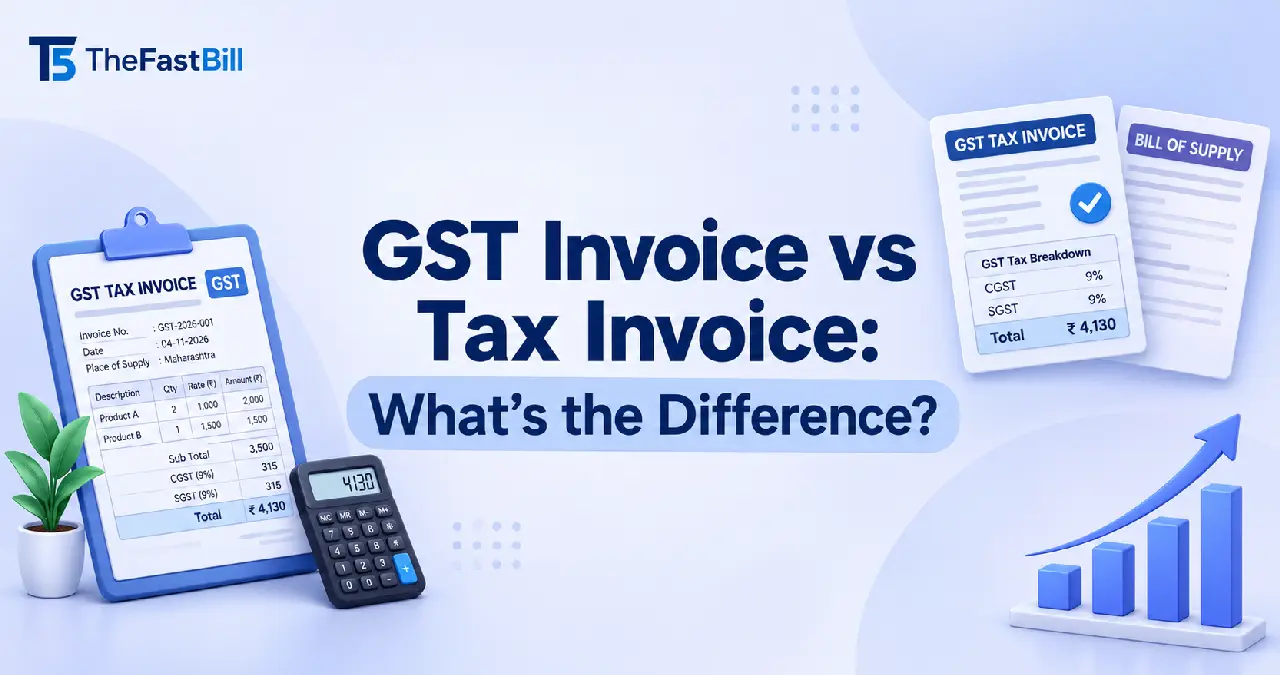
GST Invoice vs Tax Invoice: What's the Difference?

Samaun Kabir
Editor
If you run a business in India, you have probably come across the terms GST invoice and tax invoice. They may sound like two different documents, especially when a customer asks for a GST invoice while your billing software labels the document as a tax invoice.
So, is there actually a difference?
In India, a GST invoice is generally the tax invoice prescribed under the Goods and Services Tax (GST) law. The terms are commonly used interchangeably when referring to a GST-compliant invoice issued by a registered supplier for a taxable supply.
However, a tax invoice in a broader international context may refer to a document issued under another tax system, such as VAT or sales tax. This is where the terminology can become confusing.
In this guide, we explain GST Invoice vs Tax Invoice, the documents businesses should issue under Indian GST rules, the role of input tax credit (ITC), and how to avoid common invoicing mistakes.
Are GST Invoices and Tax Invoices the Same in India?
Yes. In the Indian GST context, a GST invoice generally refers to the tax invoice issued under Section 31 of the Central Goods and Services Tax (CGST) Act, 2017.
The law uses the term “tax invoice.” Businesses and accounting software often use “GST invoice” to emphasize that the document follows GST requirements.
Therefore, if your GST-registered business issues a compliant tax invoice for a taxable supply, it is commonly called a GST invoice.
The important distinction is not between the words “GST invoice” and “tax invoice.” It is between a GST tax invoice and other documents, such as:
A bill of supply
A commercial invoice issued outside the GST framework
A receipt or payment voucher
A credit note or debit note
The correct document depends on the supplier's registration status, the nature of the supply, and the applicable GST rules.
What Is a GST Tax Invoice?
A GST tax invoice is a statutory document issued by a registered supplier for a taxable supply of goods or services, subject to the applicable invoicing rules.
It records the transaction and shows the value of the supply, the GST charged, and other prescribed particulars.
Under Section 31 of the CGST Act, registered suppliers must issue tax invoices in the circumstances and within the time limits specified by law.
Purpose of a GST Tax Invoice
A GST tax invoice serves several important purposes:
Records the sale of goods or services.
Shows the taxable value and GST charged.
Helps the supplier maintain accurate sales and tax records.
Supports the recipient's input tax credit claim, where eligible.
Provides documentary evidence for accounting, compliance, and audits.
A tax invoice is particularly important in business-to-business transactions because the buyer may need it to support an eligible ITC claim.
Who Must Issue a GST Tax Invoice?
In general, a registered person supplying taxable goods or services under GST must issue a tax invoice, subject to the exceptions and special rules under the law.
However, not every GST-registered business issues a tax invoice for every transaction.
For example:
A composition taxpayer generally issues a bill of supply instead of a tax invoice.
A supplier dealing exclusively in exempt supplies generally issues a bill of supply.
Certain transactions may require specific documents or follow special invoicing provisions.
Businesses should confirm which document applies to their registration category and type of supply.
What Details Must a GST Tax Invoice Include?
Rule 46 of the CGST Rules prescribes the particulars required in a tax invoice. Depending on the transaction, these generally include:
The exact requirements can vary depending on the supply, recipient, invoice value, and applicable notifications. Businesses should refer to the current GST rules rather than assuming every field is mandatory in every case.
Example of a GST Tax Invoice
Suppose a GST-registered IT service provider in Karnataka supplies taxable services worth ₹1,00,000 to a registered business in Maharashtra.
If the transaction qualifies as an inter-State supply and the applicable GST rate is 18%, the invoice may show:
The invoice should contain the prescribed supplier and recipient details, invoice number, date, description of services, applicable SAC details, and other required particulars.
The recipient may be eligible to claim the ₹18,000 as ITC if all applicable legal conditions are satisfied.
What Is a General Tax Invoice?
Outside the specific Indian GST context, a tax invoice is a document that records a taxable sale and identifies the tax charged under the relevant jurisdiction's tax system.
The term is used in different ways across countries.
For example:
In India, a GST tax invoice is governed by GST legislation.
In countries using VAT, a tax invoice may document VAT charged on a supply.
In the United States, businesses may issue invoices showing applicable state or local sales tax.
The rules for invoice details, tax registration numbers, tax rates, reporting, and tax credits vary by jurisdiction.
A general tax invoice should not automatically be treated as a GST-compliant invoice in India. Its validity and tax treatment depend on the transaction and the applicable law.
Tax Invoice vs Commercial Invoice
A commercial invoice is primarily a business document that records a sale and supports payment, accounting, shipping, or customs processes.
A tax invoice, by contrast, is issued under the requirements of a particular tax regime when applicable.
A commercial invoice may also contain tax details, but including a tax amount does not automatically make it a valid GST tax invoice.
For Indian businesses, the document must meet the relevant GST requirements if the transaction requires a GST tax invoice.
GST Tax Invoice vs Bill of Supply
This is a more meaningful comparison under Indian GST law.
A tax invoice is generally issued for taxable supplies by a registered supplier who is required to charge GST.
A bill of supply is generally issued by a registered person for exempt supplies or by a person paying tax under the composition scheme, where applicable.
A bill of supply is not simply a less detailed invoice. It is a specific document used in circumstances prescribed under GST law.
GST Invoice vs Tax Invoice: Quick Comparison
The key takeaway is that “GST invoice” and “tax invoice” are not competing document types under Indian GST. The relevant comparison depends on whether the invoice is governed by Indian GST law or another tax regime.
Can a GST Invoice Be Used to Claim Input Tax Credit?
A GST tax invoice is an important document for claiming input tax credit, but having an invoice does not automatically make the GST credit available.
Under Section 16 of the CGST Act, a registered recipient must satisfy the applicable conditions to claim ITC.
These generally include:
The recipient must be registered and eligible to claim ITC.
The goods or services must be used or intended for use in the course or furtherance of business.
The recipient must possess a valid tax invoice or other prescribed document.
The goods or services must have been received.
The supplier must report the relevant details, and the credit must meet applicable statutory conditions.
The recipient must comply with the prescribed return and payment requirements.
Businesses should also reconcile their purchase records with the relevant GST statements, including GSTR-2B, and assess eligibility before claiming credit.
GSTR-2B is an auto-drafted ITC statement based on information reported by suppliers and other prescribed sources. It helps taxpayers assess credit availability, but taxpayers must still check eligibility under the law.
What Is GST E-Invoicing?
GST e-invoicing is a system under which specified taxpayers report prescribed invoice details to an Invoice Registration Portal (IRP).
For applicable transactions, the portal generates an Invoice Reference Number (IRN) and a signed QR code.
E-invoicing does not mean that every business must issue invoices through the IRP. It applies to notified classes of taxpayers and transactions, subject to the current rules and exemptions.
Can a GST E-Invoice Be Cancelled?
An e-invoice with an IRN generally can be cancelled through the IRP within 24 hours of generation, subject to the portal's conditions.
The IRP does not provide a facility to amend an already generated e-invoice. If the cancellation window has expired, the taxpayer may need to follow the applicable GST reporting and adjustment process, such as issuing a credit note where appropriate.
This 24-hour rule relates to cancellation through the IRP. It should not be described as a universal rule for cancelling every tax invoice.
Which Invoice Should Your Business Issue?
The correct document depends on your GST status and the type of supply.
If Your Business Is GST-Registered
If your business is registered under GST and makes taxable supplies, you generally need to issue a GST tax invoice according to the applicable rules.
This helps maintain compliance and provides customers with the documentation needed to assess eligible ITC.
If Your Business Is Under the Composition Scheme
Composition taxpayers generally issue bills of supply rather than tax invoices and cannot collect GST separately from customers on their outward supplies under the scheme.
If Your Business Is Not GST-Registered
An unregistered business should not issue a GST tax invoice or collect GST as though it were registered.
It may issue an ordinary commercial invoice or bill, depending on the transaction and other applicable legal requirements.
If You Sell Internationally
International transactions may involve GST export provisions, VAT, sales tax, customs documentation, or other local rules.
Do not assume that a foreign tax invoice automatically meets Indian GST requirements. Determine the place of supply, export status, registration obligations, and applicable documentation before issuing the invoice.
Common GST Invoicing Mistakes to Avoid
Businesses can reduce invoicing errors by checking the following:
Using the wrong document: Issuing a tax invoice instead of a bill of supply when the law requires the latter.
Incorrect GSTIN: Entering an incorrect supplier or recipient GSTIN.
Wrong tax classification: Using an incorrect HSN or SAC code.
Incorrect tax calculation: Applying the wrong GST rate or tax component.
Ignoring place of supply: Charging CGST/SGST instead of IGST, or vice versa, where applicable.
Assuming ITC is automatic: Claiming credit without checking statutory eligibility.
Missing invoice particulars: Leaving out required details under the GST rules.
Incorrect e-invoice handling: Failing to follow IRP requirements for transactions covered by e-invoicing.
Using reliable GST billing software can help standardize invoice formats, calculate taxes, and organize transaction records. However, businesses remain responsible for ensuring that their invoices comply with the applicable law.
Conclusion
Understanding GST Invoice vs Tax Invoice is important for businesses that want to maintain accurate billing records and comply with Indian GST requirements.
In India, a GST invoice is generally the tax invoice issued under GST law. The terms are commonly used interchangeably, while bills of supply and ordinary commercial invoices serve different purposes.
If your business is GST-registered and makes taxable supplies, issue a compliant tax invoice. If you operate under the composition scheme or make exempt supplies, check whether a bill of supply is required.
For ITC, remember that a valid invoice is only one part of the eligibility requirements. Review the applicable GST rules, supplier reporting, and recipient conditions before claiming credit.
For easier invoice creation and record management, businesses can consider GST billing software that supports their invoicing workflow. The right process helps reduce avoidable errors and keeps business records organized.
Note: GST rules, notifications, and e-invoicing requirements may change. Verify the latest applicable provisions or consult a qualified tax professional for transaction-specific advice.