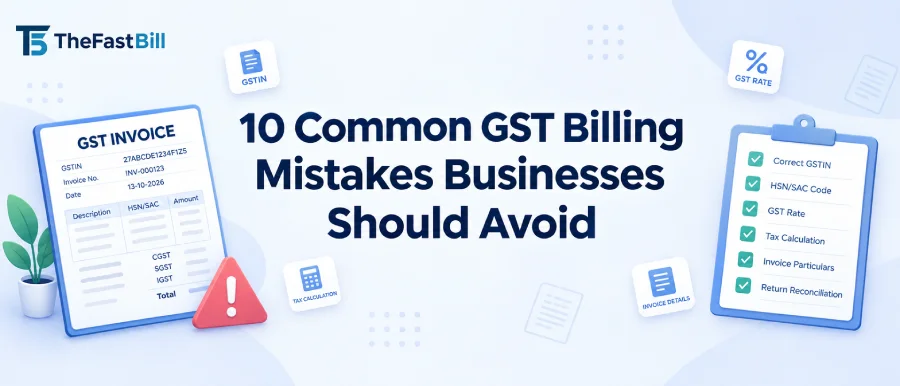
10 Common GST Billing Mistakes Businesses Should Avoid

Samaun Kabir
Editor
GST billing mistakes can create problems for Indian businesses, from incorrect tax calculations and invoice discrepancies to delayed input tax credit (ITC) claims and GST compliance issues. Even a small data-entry error can affect accounting records, customer relationships, and the accuracy of GST returns.
For retailers, wholesalers, manufacturers, and service providers, accurate invoicing is an essential part of daily business operations. Businesses need to apply the correct GST rate, maintain proper invoice records, reconcile transactions, and report information accurately in their GST returns.
The good news is that many common GST billing mistakes can be reduced through consistent verification, clear accounting procedures, and reliable billing software.
In this guide, we explain 10 common GST billing mistakes, why they matter, and how businesses can prevent them.
If you are looking for a practical way to improve invoice accuracy and organize your business records, you can also read our guide on why to choose GST billing software for your business.
What Are GST Billing Mistakes?
GST billing mistakes are errors made while preparing tax invoices, calculating GST, recording transactions, claiming input tax credit, or reporting sales and purchases in GST returns.
These mistakes can occur because of incorrect data entry, outdated tax information, wrong product classification, inadequate documentation, or a lack of reconciliation between accounting records and GST filings.
Common examples include:
Entering an incorrect GSTIN on an invoice.
Applying the wrong GST rate to a product or service.
Using an incorrect HSN or SAC code.
Calculating CGST, SGST, or IGST incorrectly.
Issuing invoices with missing mandatory particulars.
Claiming ineligible input tax credit.
Reporting incorrect sales information in GST returns.
Understanding these errors helps businesses establish better billing procedures and identify problems before they lead to more significant compliance issues.
10 Common GST Billing Mistakes and How to Avoid Them
1. Entering Incorrect GSTIN or Customer Details
One of the most common GST billing mistakes is entering incorrect information about the supplier or customer.
A GSTIN contains important information used to identify a registered taxpayer. If a business enters the wrong GSTIN, customer name, billing address, or delivery details, the invoice may not accurately reflect the transaction.
For example, a wholesaler selling garments to a registered retailer might accidentally enter another customer's GSTIN. The invoice would then contain incorrect recipient information, potentially creating reconciliation difficulties and affecting the recipient's ITC process.
Incorrect details can also cause problems when businesses upload invoice information to their GST returns.
How to prevent this mistake
Verify the customer's GSTIN and legal business name before issuing the invoice.
Maintain accurate customer and supplier records.
Confirm billing and delivery addresses.
Review GST registration details when a customer changes business information.
Check invoice information before finalizing or sending it.
Businesses should also keep their own GST registration details accurate and update them through the prescribed process whenever a reportable change occurs.
A billing system that stores verified customer information can reduce repeated manual entry and help prevent avoidable errors.
2. Applying the Wrong HSN or SAC Code
The Harmonized System of Nomenclature (HSN) is used to classify goods, while the Service Accounting Code (SAC) is used to classify services for GST purposes.
Using an incorrect classification can result in an incorrect GST rate, inaccurate reporting, or questions from tax authorities.
For example, a retailer may sell several products with different classifications but assign the same HSN code to every item. If those classifications are not appropriate, the resulting invoices may contain incorrect tax information.
HSN and SAC classification should not be based on a product's name alone. The relevant product characteristics, service description, applicable GST notifications, and classification rules may need to be considered.
How to prevent this mistake
Identify the correct classification for each product or service.
Check the applicable HSN or SAC requirements for your business.
Verify the GST rate against current official notifications.
Review classifications when introducing new products or services.
Seek professional advice when a classification is uncertain.
Do not assume that products with similar names always attract the same GST treatment. Classification and rates must be verified for the specific goods or services involved.
3. Charging the Incorrect GST Rate
Applying the wrong GST rate can lead to undercharging or overcharging customers and may require subsequent corrections.
The applicable GST rate depends on the classification of the supply and the relevant legal provisions and notifications. Businesses should not rely solely on old invoices, supplier assumptions, or outdated spreadsheets.
For example, a business might continue using a previously configured rate after a relevant rate notification changes the treatment of a product. New invoices could then contain incorrect tax amounts.
How to prevent this mistake
Verify the current GST rate for each relevant product or service.
Maintain an accurate product and service tax-rate database.
Review official GST rate notifications when changes are announced.
Update billing configurations after confirming that a change applies.
Check the tax rate before issuing invoices for newly introduced items.
GST billing software can help apply configured rates consistently, but businesses must ensure that the underlying product classification and tax settings are correct and updated.
4. Calculating Taxable Value and GST Incorrectly
Another common billing problem is calculating the taxable value or GST amount incorrectly.
Errors may occur when staff enter the wrong quantity, apply an incorrect discount, calculate tax on the wrong amount, or manually work out the final invoice value.
Consider this simple example.
A business sells goods with a taxable value of ₹10,000, assuming a hypothetical applicable GST rate of 18%.
Taxable value: ₹10,000
GST at 18%: ₹1,800
Total invoice value: ₹11,800
If the business mistakenly calculates GST as ₹1,080, the invoice total will be incorrect.
This example assumes that the entire stated amount is taxable at 18%, with no additional adjustments or special treatment. Actual invoice calculations must follow the applicable GST rules.
How to prevent this mistake
Verify product quantities and prices.
Check how discounts and other adjustments affect taxable value.
Confirm that the correct tax rate is applied.
Review invoice totals before issuing them.
Use automated calculations where appropriate.
For businesses processing many transactions each day, automated billing calculations can reduce arithmetic errors and make invoice preparation more consistent.
5. Applying CGST, SGST, and IGST Incorrectly
Businesses must also determine whether a transaction should attract Central GST (CGST) and State GST (SGST), or Integrated GST (IGST).
The treatment depends on the applicable place-of-supply rules and whether the supply is classified as intra-State or inter-State.
A common mistake is assuming that the customer's address alone always determines which tax applies.
For example, a business may apply CGST and SGST to a transaction that should be treated as an inter-State supply. This can lead to incorrect invoices and additional work to reconcile the tax records.
How to prevent this mistake
Identify the supplier's location and relevant place of supply.
Determine whether the transaction is intra-State or inter-State under the applicable rules.
Configure tax treatment correctly in the billing system.
Verify special transaction types, including exports and supplies involving distinct registrations, where relevant.
Seek professional guidance when place-of-supply treatment is unclear.
Correct tax treatment is particularly important for businesses selling goods or services across State boundaries.
6. Issuing Invoices With Missing or Incorrect Particulars
A tax invoice must contain the particulars required under the applicable GST rules. An invoice with missing or incorrect information can create documentation and reconciliation problems.
Depending on the transaction and applicable requirements, invoice particulars may include the supplier's name, address and GSTIN, a unique consecutive serial number, invoice date, recipient details, HSN or SAC information, description of goods or services, taxable value, applicable tax rate, tax amount, and relevant place-of-supply details.
Other requirements may apply to particular invoice types or transactions.
For example, a business might issue an invoice without the correct serial number or omit required tax information. This can complicate record-keeping and make it harder to establish that the invoice accurately represents the transaction.
How to prevent this mistake
Use an invoice format designed around applicable GST requirements.
Check that all mandatory particulars are present.
Maintain unique invoice numbering according to the applicable rules.
Verify customer information and transaction descriptions.
Review special requirements applicable to your business or transaction type.
For a step-by-step explanation, read our guide on how to create a GST invoice.
Official reference: CBIC GST Invoice Rules.
7. Claiming Ineligible Input Tax Credit
Input Tax Credit (ITC) allows eligible registered businesses to claim credit for qualifying GST paid on business inputs, subject to statutory conditions.
However, not every purchase qualifies for ITC. Restrictions, blocked-credit provisions, documentation requirements, and other eligibility conditions can affect whether a business may claim credit.
Problems can arise when businesses claim ITC on ineligible expenses, enter incorrect invoice details, fail to reconcile purchase records, or assume that every invoice automatically qualifies.
For example, a business might record a purchase invoice in its accounting system and claim the associated GST without checking whether the credit is permitted under the applicable provisions.
How to prevent this mistake
Confirm that the purchase qualifies for ITC under the applicable law.
Maintain valid invoices and supporting documentation.
Verify that the relevant goods or services have been received where required.
Reconcile purchase records with GSTR-2B and other relevant information.
Review blocked-credit provisions and other statutory conditions.
Correct discrepancies through the appropriate process.
GSTR-2B is an important reconciliation statement, but its contents should not be treated as the only test of ITC eligibility. Businesses must also satisfy the other applicable legal conditions.
Official reference: GST Portal GSTR-2B FAQs.
8. Making Errors in GST Return Filing and Reconciliation
Preparing accurate invoices is only one part of GST compliance. Businesses must also report transaction information correctly in the applicable GST returns.
For example, outward supply details reported in GSTR-1 should be reconciled with the underlying sales records and the corresponding accounting information. Tax liabilities reported in GSTR-3B should also be checked against the books and applicable tax calculations.
Differences may arise because of omitted invoices, duplicate entries, incorrect taxable values, credit notes, amendments, or transactions recorded in the wrong period.
Such discrepancies can make it harder to establish accurate turnover and tax liabilities.
How to prevent this mistake
Reconcile sales invoices with the outward supply information reported in GSTR-1.
Compare tax liabilities with accounting records before filing GSTR-3B.
Identify missing, duplicated, or incorrectly recorded invoices.
Review credit notes, debit notes, and permitted amendments.
Maintain a compliance calendar for applicable filing and payment deadlines.
Keep evidence of reviews and corrections.
The filing frequency and due dates depend on the taxpayer's category and applicable requirements. Businesses should verify their current filing obligations through the GST Portal rather than relying on a generic calendar.
Official reference: GST Portal GSTR-1 Guidance.
9. Overlooking Reverse Charge Mechanism Obligations
Under the Reverse Charge Mechanism (RCM), the recipient is liable to pay GST instead of the supplier in specified circumstances.
The mechanism applies only where the relevant legal provisions and notifications require it. Businesses therefore need to identify transactions that fall within the applicable reverse-charge rules rather than assuming that every purchase is subject to RCM.
A company may overlook an eligible reverse-charge transaction because its accounting team treats all supplier invoices in the same way. This can result in an omitted tax liability or incorrect reporting.
How to prevent this mistake
Review transactions against the applicable reverse-charge provisions and notifications.
Identify relevant goods, services, and supplier categories.
Maintain separate records for transactions requiring reverse-charge treatment.
Check the applicable tax rate and payment obligations.
Report the liability correctly in the relevant returns.
Review ITC eligibility separately, because credit depends on the applicable statutory conditions.
Regular reviews of vendor invoices and expense records can help identify transactions that need special GST treatment.
10. Neglecting Supplier Compliance and GST Notices
Supplier documentation and compliance can affect the quality of a business's own GST records. At the same time, businesses must monitor their own GST Portal communications and respond to notices or requests within the applicable time limits.
For example, a supplier may fail to report an invoice correctly, causing a discrepancy between the purchaser's records and the information available through the GST system. The purchaser may then need to contact the supplier and reconcile the transaction.
Separately, ignoring a GST notice may result in missed opportunities to provide information, correct a discrepancy, or respond within the prescribed period.
How to prevent this mistake
Verify supplier details when establishing business relationships.
Reconcile purchase invoices with supplier-reported information.
Follow up on missing or incorrect invoice records.
Monitor the GST Portal and registered email address.
Record notice dates and response deadlines.
Consult a qualified GST professional when a notice requires a legal or technical response.
Supplier verification and notice monitoring should form part of a regular compliance process, not just an activity undertaken at the time of filing returns.
GST Billing Mistakes: Quick Prevention Checklist
Use this checklist before finalizing invoices and preparing GST returns.
A checklist is most effective when it is incorporated into the business's regular billing and accounting procedures.
How GST Billing Software Can Help Prevent Billing Mistakes
Manual billing can become difficult to manage as the number of products, customers, transactions, and invoices increases. Repeated data entry and disconnected records can also make it harder to identify discrepancies before filing returns.
GST billing software can help businesses organize their invoicing and accounting workflows.
Depending on the features available, a suitable system may help with:
Automated tax calculations: Configured tax rates and calculation rules can reduce manual arithmetic errors.
Consistent invoice formats: Standardized invoice templates help teams capture the required information more consistently.
Organized transaction records: Digital records can make sales, purchases, and invoice details easier to retrieve and review.
Inventory and sales tracking: For retail businesses, linking billing with inventory records can help reduce discrepancies between sales and stock information.
Reporting and reconciliation support: Suitable reporting features can help businesses review transactions before preparing GST returns.
Faster invoice preparation: Saved customer and product information can reduce repeated data entry.
Software does not automatically guarantee GST compliance. Businesses must verify tax settings, review the applicable rules, and ensure that invoices and returns are accurate.
If you want to understand how billing software can support your operations, explore why to choose GST billing software for your business.
You can also review TheFastBill pricing and available features to determine whether the solution meets your business's requirements.
What Should You Do If You Discover a GST Billing Mistake?
Finding a billing error does not necessarily mean that the problem cannot be corrected. However, the correct procedure depends on the type of error, the relevant transaction, the document involved, and the applicable GST rules.
Follow these general steps:
Identify the error. Determine whether it concerns the GSTIN, invoice number, tax rate, taxable value, classification, or tax treatment.
Assess the impact. Check whether the error affects the customer invoice, accounting records, tax liability, ITC, or a return already filed.
Determine the appropriate correction. Depending on the circumstances, a permitted amendment, credit note, debit note, or another prescribed procedure may be relevant.
Update the records. Maintain the original documentation and a clear record of the correction.
Review the tax consequences. Check whether additional tax, interest, or other compliance action may be required.
Seek professional guidance when necessary. Consult a qualified GST professional for material discrepancies, disputed ITC, notices, or errors involving statutory deadlines.
Do not simply edit or replace an issued invoice without checking the permitted procedure. Not every error can be corrected in the same way.
Conclusion
GST billing mistakes can affect invoice accuracy, tax calculations, accounting records, ITC reconciliation, and return filing. Although some errors may be minor, others can create additional compliance work or financial consequences.
Businesses can reduce these risks by verifying invoice details, applying the correct tax treatment, maintaining proper records, reviewing ITC eligibility, reconciling GST returns, and monitoring compliance deadlines.
A consistent billing process supported by suitable software can make these tasks easier to manage. The key is to combine accurate data, up-to-date tax information, regular reviews, and professional guidance whenever required.
If you want to simplify your invoicing workflow and improve transaction record management, explore TheFastBill's available billing solutions and choose a setup that fits your business needs.